
Last Updated: October 26, 2026
Quick Summary
Medical dental crossover billing refers to the practice of submitting dental procedures to medical insurance rather than dental insurance when those services qualify under medical coverage criteria. This occurs when a dental procedure meets medical necessity criteria and addresses a documented medical condition, such as oral surgery for airway obstruction or periodontal treatment linked to systemic conditions like diabetes.
Medical dental crossover billing refers to the practice of submitting dental procedures to medical insurance rather than dental insurance when those services qualify under medical coverage criteria. This is distinct from traditional dental billing, where claims go directly to a patient’s dental plan.
The confusion often starts here: there are actually two meanings of “crossover” in healthcare billing. The first, which we’re covering in depth, involves dental services billed to medical insurance. The second refers to Medicare crossover claims, where claims automatically transfer from Medicare to a supplemental insurer. We’ll address both, but the primary focus is dental-to-medical billing.
When a dental procedure meets medical necessity criteria, it may be covered under a patient’s medical plan instead of their dental plan. This happens most commonly with oral surgery, orthodontics related to sleep apnea, or periodontal treatment linked to systemic conditions. The key distinction: the procedure must serve a medical purpose, not merely a cosmetic or preventive dental one.
Dental services cross over to medical insurance when they address a documented medical condition rather than routine dental care. Medical necessity is the threshold. A periodontal procedure might qualify if it’s treating a systemic infection that impacts overall health. An oral surgery might qualify if it’s removing impacted teeth causing airway obstruction or sleep apnea symptoms.
The coverage criteria vary significantly by payer. Medicare has specific guidelines for which oral procedures qualify (Medicare Dental Coverage). Commercial insurers maintain their own medical policy documents. Medicaid programs differ by state. This payer-by-payer variation is where many practices stumble, they assume one payer’s rules apply across the board and miss coverage opportunities with others.
Common dental services that sometimes qualify for medical coverage include:
The critical factor is documentation. Without clinical notes establishing the medical necessity and linking the procedure to a diagnosed condition, the claim will be denied regardless of whether coverage exists. This is where many practices fail, they submit the procedure code without the supporting clinical narrative.
Not every dental procedure can be billed to medical insurance, and attempting to do so without proper justification triggers denials.
Oral surgery represents the largest category of crossover procedures. Extraction of impacted wisdom teeth, removal of oral cysts or tumors, and surgical correction of jaw deformities can all qualify under medical billing when medically necessary.
Orthodontic treatment occasionally crosses over when it’s treating sleep apnea, severe malocclusion affecting airway function, or TMJ-related dysfunction. Standard cosmetic orthodontics stays in the dental realm.
Periodontal procedures can qualify when treating active periodontal disease linked to systemic conditions. A patient with uncontrolled diabetes experiencing rapid periodontal deterioration might have scaling and root planing covered under medical billing if properly documented.
The distinction matters because medical plans typically have higher reimbursement rates, different deductibles, and different out-of-pocket maximums than dental plans.
These dental procedures most commonly qualify for medical insurance billing when medically necessary.
| Procedure | Medical Qualifier | Billing Category |
|---|---|---|
| Oral surgery for impacted teeth | Affecting airway or sleep function | Medical |
| Orthognathic surgery | Jaw reconstruction, medically necessary | Medical |
| Orthodontic treatment | Sleep apnea or TMJ dysfunction | Medical |
| Periodontal scaling and root planing | Linked to systemic conditions like diabetes | Medical |
| Removal of oral lesions or tumors | Benign lesions or tumors | Medical |
| Routine cosmetic orthodontics | Cosmetic purposes only | Dental |
Medical dental cross coding requires translating dental procedures into medical terminology and codes. This is where many practices encounter their biggest compliance and reimbursement challenges.
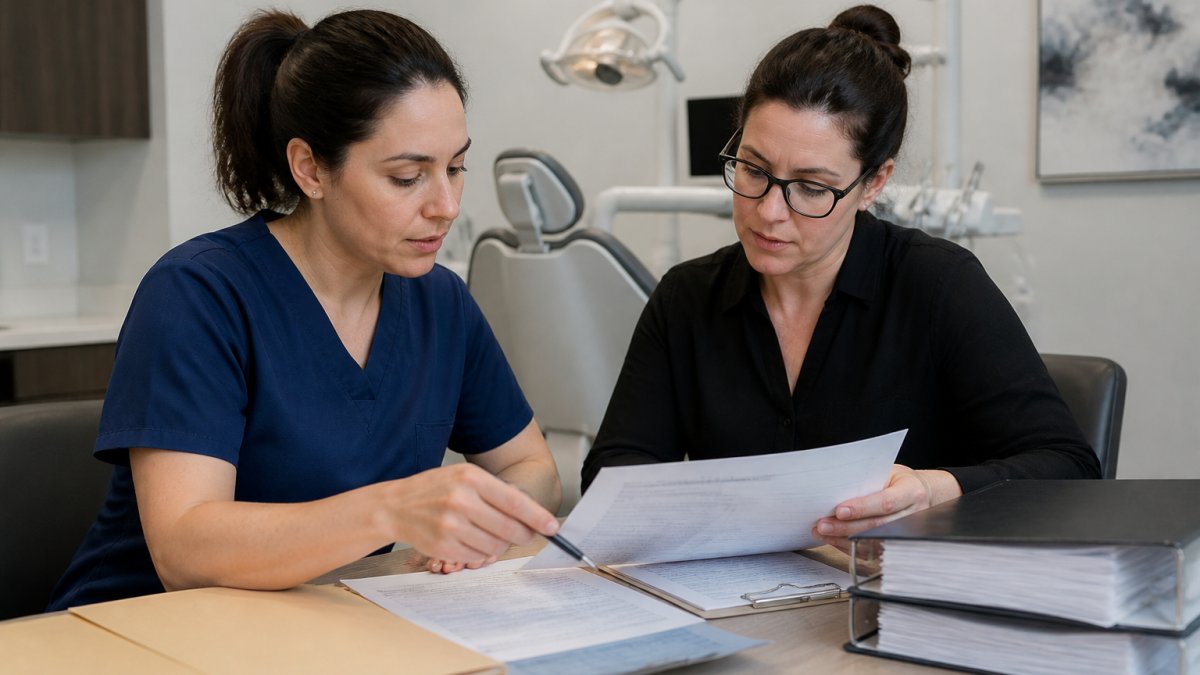
A dental extraction coded with a CDT code (D7xxx series) will be rejected by a medical insurance payer expecting a CPT code (like 41800 or 41805).
CPT codes are the standard for medical billing. When a dental procedure qualifies for medical coverage, it must be coded using the Current Procedural Terminology system.
Here’s where it gets complicated: the same procedure might use different CPT codes depending on the clinical context.
Practices often struggle with code selection because it requires clinical judgment tied to documented findings. You cannot code based on assumptions.
CDT codes exist for dental procedures and are appropriate when billing dental insurance. When the same procedure crosses to medical insurance, CDT codes are incorrect. This fundamental distinction trips up many practices.
Medical dental crossover claims fail at the documentation stage more often than any other point. A claim can have perfect coding and still be denied if the supporting documentation doesn’t establish medical necessity.
The clinical record must contain specific elements. A diagnosis code alone isn’t sufficient.
For periodontal crossover claims, the documentation must link the periodontal condition to a systemic disease. A note stating “patient has diabetes and periodontal disease” doesn’t establish medical necessity.
Insurance forms matter. The CMS-1500 form is standard for medical claims. Some payers require additional documentation forms or prior authorization requests.
Get a Practice Checkup For Free →
Prior authorization represents another documentation hurdle. Many payers require approval before performing dental procedures billed to medical insurance. Submitting a claim without prior authorization when it’s required guarantees denial.
Coordination of benefits adds another layer. When a patient has both medical and dental insurance, determining which plan is primary matters. Typically, dental insurance is primary for dental procedures.
Denial prevention starts with accurate eligibility verification and plan review before treatment begins. Many practices submit claims without confirming whether the specific procedure is covered under the patient’s medical plan. A five-minute eligibility call prevents weeks of denial management.
When verifying eligibility, ask specific questions: Does the plan cover oral surgery? Are there frequency limitations? Is prior authorization required? What documentation does the plan require? These details vary dramatically between payers. Medicare has different rules than commercial plans.
Common denial reasons for crossover claims include missing prior authorization, insufficient clinical documentation, incorrect coding, and lack of medical necessity. Each requires a different appeal strategy. Learn how to reduce dental claim denials with a step-by-step approach that addresses prevention, documentation, and appeal workflows.
Appeals should include resubmitted clinical documentation that directly addresses the denial reason.
Timeliness matters. Most payers have appeal deadlines ranging from 30 to 180 days depending on the payer and claim type. Missing the deadline eliminates appeal rights. Tracking appeal deadlines is critical for practices managing multiple denials.
Some denials can be appealed directly to the payer. Others require going through an independent review process.
Optimization begins with identifying which procedures in your practice qualify for crossover billing. Review your case mix. Do you perform oral surgery?
Once you’ve identified crossover cases, establish protocols. Create a checklist for verifying eligibility before treatment.
Explore dental billing fundamentals to ensure your team understands the distinction between dental and medical billing systems, which directly impacts crossover claim success.
Understand medical billing basics so your coding and documentation align with medical payer expectations rather than defaulting to dental payer conventions.
Payer policies change. A procedure covered under one payer’s medical plan last year might be excluded this year.
Denial tracking and analysis reveal patterns.
Revenue cycle metrics matter. Track your clean-claim rate (claims accepted on first submission), denial rate, days in accounts receivable, and appeal overturn rate.
For practices struggling with crossover billing complexity, outsourced support can be an option. Explore RCM and practice management services.
Medical dental crossover billing represents a potential revenue opportunity for practices. The challenge isn’t the concept, it’s the execution.
Medical dental crossover billing refers to billing dental procedures to a patient’s medical insurance plan rather than their dental insurance, when those procedures meet medical necessity criteria. This occurs when a dental service is integral to treating a medical condition, such as oral surgery for trauma, tooth extraction before radiation therapy, or periodontal treatment related to systemic disease. Crossover billing also describes Medicare claims that automatically transfer to supplemental insurance after primary payment, though this second meaning applies differently to dental coverage under specific conditions.
A dental procedure qualifies for medical insurance billing when it is medically necessary and directly related to treating a medical condition rather than routine dental care. Common scenarios include oral surgery for jaw fractures, tooth extractions before cancer treatment, periodontal procedures for diabetic management, or dental work required before cardiac surgery. The key is establishing medical necessity through clinical documentation linking the dental service to the patient’s medical diagnosis. Coverage varies significantly by payer and plan, so verification of benefits before treatment is essential to confirm eligibility.
Dental crossover claim documentation must include a clear clinical narrative explaining the medical necessity, the patient’s relevant medical diagnosis (ICD-10-CM codes), the specific dental procedure performed (CDT or CPT codes depending on the service), supporting clinical records such as imaging or pathology reports, the treating provider’s credentials and NPI number, and the medical condition that necessitated the dental treatment. The claim form (CMS-1500 for medical) must be completed accurately with all required fields. Prior authorization documentation, if obtained, should accompany the claim. Incomplete or unclear documentation is a leading cause of denial.
Dental claim denial prevention starts with verifying medical necessity and coverage eligibility before treatment begins. Use correct code pairing: match the dental procedure code (CDT or CPT) with the appropriate ICD-10-CM diagnosis code that justifies medical necessity. Submit complete clinical documentation with every claim, including the provider’s medical justification. Follow the payer’s specific submission requirements and prior authorization protocols. Track claim status actively and respond promptly to requests for additional information. When denials occur, review the denial reason code, correct the error, and resubmit. Many denials result from coding errors or missing documentation rather than coverage exclusions.
Dental insurance typically covers preventive, restorative, and routine procedures with set benefit limits and exclusions for certain services. Medical insurance covers services necessary to diagnose or treat a medical condition. In crossover billing, a dental procedure moves from the dental policy’s coverage rules to the medical policy’s medical necessity framework. Medical insurance may cover procedures dental insurance excludes if medical necessity is established. However, coordination of benefits rules require the primary payer (often dental) to be billed first. Understanding each payer’s coverage criteria and submission requirements is critical to successful crossover claims.
Coordination of benefits rules generally require billing the patient’s dental insurance first, even on crossover claims, unless the procedure is clearly outside dental coverage. Once dental insurance denies the claim or confirms no coverage, the claim can be resubmitted to medical insurance as a secondary claim with documentation of the denial and medical necessity. Some payers have specific coordination rules, so verification of benefits should clarify the billing sequence. Billing medical first without exhausting dental benefits may result in medical insurance denying the claim as not their primary responsibility.
Crossover claim denials typically stem from insufficient clinical documentation of medical necessity, incorrect code pairing that fails to link the dental procedure to a medical diagnosis, missing prior authorization when required, billing sequence violations (billing medical before dental), incomplete claim submission, or payer policy exclusions specific to the service. Some payers deny crossover claims simply because they do not cover dental services regardless of medical necessity. Others deny due to the provider not being in-network for dental services under their medical plan. Reviewing the specific denial reason code and the payer’s policy is essential to determining whether resubmission or appeal is appropriate.
